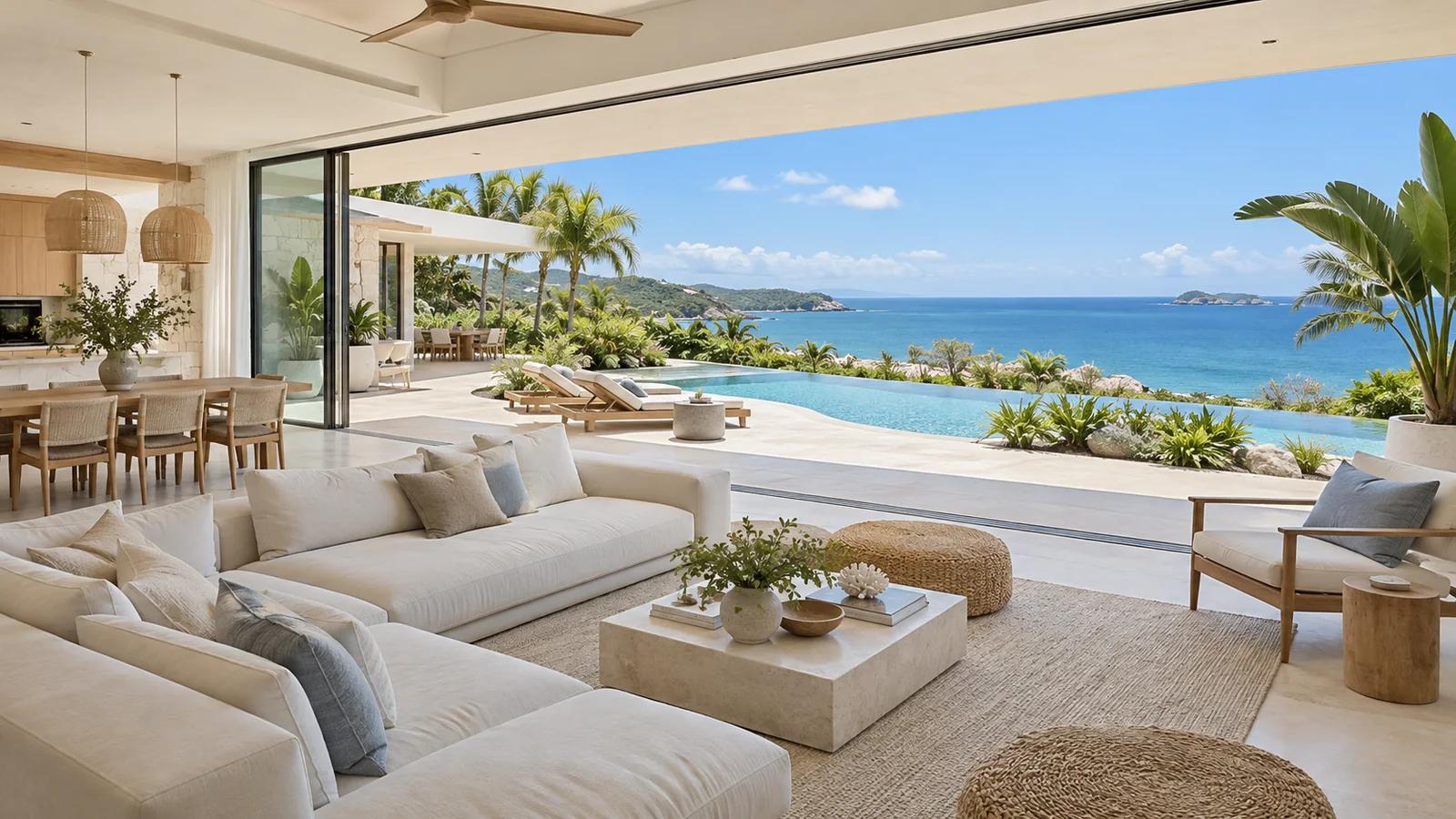
Start with orientation.
A buyer should be able to understand what they are seeing before moving through a gallery. Establish the overall setting and the relationship between the home and its landscape. Then show how living spaces connect, where private rooms sit, and what outdoor areas add. Accurate plans and captions supplied by the listing team can provide context that photographs alone cannot.
Use detail with a purpose.
A photograph of stone, joinery, or a threshold can communicate material quality. It earns its place when the surrounding content explains why that detail matters to the architecture or the experience of the home. Avoid a gallery made entirely of atmospheric fragments. Give the buyer enough whole-space imagery to judge proportions and connections as well as finish.
Match discovery to the collection.
A curated group of a few residences may need a simple overview with consistent facts. A large inventory may need search and filters driven by an authorized listing feed. Decide which model fits before designing the interface. Filters should describe distinctions the data can reliably support; an attractive control is unhelpful when most listings have missing values.
Give changing facts a clear owner.
Availability, pricing, specifications, and inquiry contacts can change independently of a photographic story. Establish who approves those details and how updates reach the website. Do not allow a static editorial page to imply current availability if the operational source says otherwise. Integration and content maintenance belong in the original brief, not only in the launch checklist.
Carry context into the conversation.
A property inquiry should make it clear which home the visitor is asking about. Offer a focused next step such as requesting details or arranging a showing, with only the information needed to begin. Our Lanikai Collection concept explores the presentation of an architectural collection; its invented properties are a design study, not available listings or evidence of sales performance.